Table of Contents
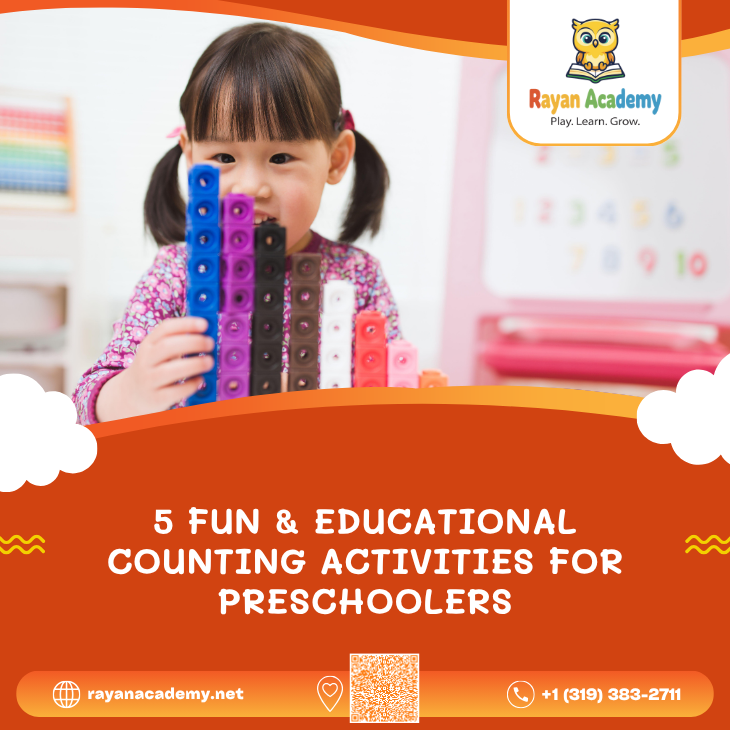
5 Fun & Educational Counting Activities for Preschoolers
Every parent has seen it — a child proudly holding up three fingers to show their age, or carefully counting the strawberries on their plate before eating each one. These small, joyful moments are actually big milestones. Counting is one of the earliest and most important math skills a child develops, and the way it’s introduced can shape how they feel about learning for years to come. If you’re searching for counting activities for preschoolers that are engaging, developmentally appropriate, and genuinely fun, you’re in the right place.
For families in Coralville and Iowa City, finding an environment that nurtures this kind of early learning is a real priority. Parents want to know their child isn’t just being supervised — they want their little one to be growing, exploring, and building the skills they’ll need for kindergarten and beyond. At Rayan Academy, our experienced educators understand that math learning for preschoolers isn’t about worksheets and memorization. It’s about curiosity, play, and hands-on discovery woven into every part of the day.
In this guide, we’ll share practical counting activities for preschool that you can try at home or look for in a quality early education setting, explain why counting matters so much at this age, and offer insight into how a thoughtful daycare program turns everyday moments into powerful learning experiences.
Why Counting Skills Matter in Early Childhood
When a three-year-old counts a row of blocks, they’re doing far more than reciting words in sequence. They’re developing one-to-one correspondence — the understanding that each object gets exactly one number. They’re building concepts of quantity, order, and comparison — the very building blocks of mathematical thinking and logical reasoning.
Here’s what the research tells us:
- Children who develop strong number sense before kindergarten consistently outperform their peers in elementary math and reading comprehension.
- Early counting ability predicts later problem-solving skills, not just in math but across all academic subjects.
- The method matters more than the content. Young children learn math best when it feels like play, not pressure — which is why the most effective counting activities for preschoolers are embedded in games, songs, art, and daily routines rather than drills.
Supporting Emotional and Social Growth
What many parents don’t realize is that counting activities quietly strengthen emotional development too. Picture a child who successfully counts a set of objects and hears an adult say, “You got it!” That moment builds something deeper than math skills — it builds a child’s belief in themselves.
When children count together during group activities, the benefits multiply:
- They practice cooperation — sharing materials, waiting for a turn, celebrating a friend’s success.
- They develop communication skills — explaining how they counted, asking questions, and describing quantities.
- They build resilience — making mistakes, trying again, and discovering that errors are part of learning.
At Rayan Academy, our learning approach is intentionally designed to nurture the whole child, weaving math skills into activities that also support emotional well-being and meaningful social interaction.
Engaging Counting Activities for Preschoolers
At Rayan Academy, even nutrition moments are treated as learning opportunities. Our educators ask counting questions during meals, encourage children to serve themselves specific quantities, and use food vocabulary that builds both math and language skills — because great days start with great nutrition and great thinking.
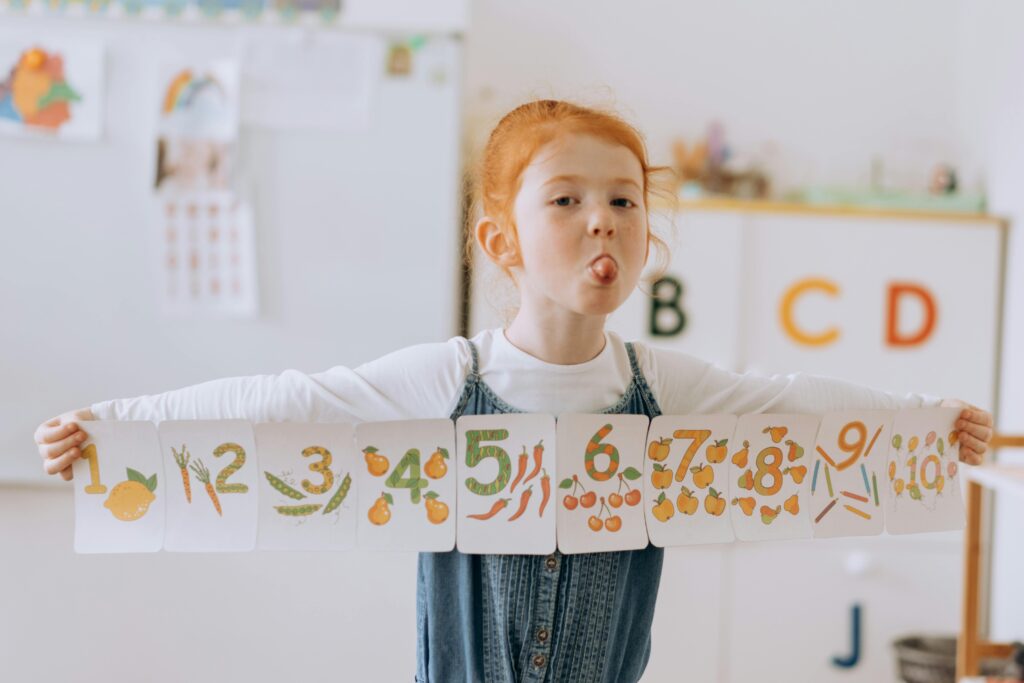
1. Counting with Everyday Objects
One of the simplest and most effective math counting activities for preschoolers uses objects children already encounter daily. Buttons, crayons, toy cars, pieces of fruit — any collection of small items becomes a counting lesson when an adult guides the experience with purpose.
Try these at home tonight:
- Set the table together. Ask your child to place one fork beside each plate, reinforcing one-to-one correspondence without them even realizing it.
- Sort the laundry. “Can you count how many socks are blue?” Sorting and counting simultaneously strengthens categorization skills alongside number sense.
- Count the stairs. Every time you walk upstairs, count each step aloud together. Repetition through routine is one of the most powerful learning tools at this age.
This approach works beautifully because it connects abstract numbers to real, tangible things a child can touch, move, and understand. No special materials needed — making this one of the best counting activities for preschoolers at home.
2. Number Songs and Movement Games
Music does something remarkable to a young brain. When a child sings “Five Little Ducks” or “Ten in the Bed,” they’re not just memorizing lyrics — they’re internalizing number sequences, practicing subtraction concepts, and strengthening memory recall, all while having the time of their life.
At Rayan Academy, our morning huddles often begin with music and rhymes that get children moving, singing, and counting together — a cheerful start that sets the tone for a day full of discovery. To take this further at home, try pairing songs with physical movement:
- Call out a number and ask your child to jump that many times.
- Clap a rhythm and have your child count the claps, then repeat the pattern.
- Play freeze dance — when the music stops, hold up a number card and ask your child to stomp that many times before dancing again.
This kinesthetic approach helps children who learn best through movement internalize number concepts far more effectively than sitting still ever could.
3. Sensory Bin Counting
Fill a bin with rice, dried beans, or sand. Hide small objects inside — plastic animals, colored gems, or letter tiles. Give your child a number card and ask them to dig, discover, and count out exactly that many items.
Why do preschool teachers love this activity?
Sensory bins hold a child’s attention for remarkably long stretches because the tactile experience of digging and discovering is inherently rewarding. Meanwhile, the counting task layered on top builds number recognition, fine motor control, and focus — all at once. Teachers can also observe each child’s counting ability in an informal, pressure-free setting, which helps them tailor instruction to individual needs.
For added challenge, ask your child to sort their found objects by color or type and then count each group. This introduces early data classification — a skill that connects counting to broader mathematical thinking.
4. Counting Through Art and Creative Projects
Creative projects offer a natural bridge between imagination and math skills. The beauty of art-based counting activities for preschoolers is that the child focuses on creating something they’re proud of — and the counting happens almost effortlessly along the way.
Try these at your kitchen table:
- Dot painting — Write a number on a card. Your child uses a cotton swab dipped in paint to stamp exactly that many dots onto paper. It’s simple, messy in the best way, and deeply satisfying for little hands.
- Nature collage — After a walk outside, have your child count and arrange collected leaves, pebbles, or sticks into groups of two, three, or five, then glue them onto cardboard.
- Sticker stories — Draw a simple scene (a tree, a pond, a house) and ask your child to add a specific number of stickers: “Put four birds in the sky. Now add three fish in the pond.”
Each finished project becomes a source of pride that children love sharing with family — reinforcing both their counting skills and their confidence.
5. Snack-Time Math
Snack time might be the most underrated learning window of the day. Because food is naturally motivating, children engage with counting activity for preschoolers built around snacks with genuine enthusiasm.
Here’s how a simple snack becomes a math lesson:
Ask your child to count out five crackers onto their plate. Then ask, “If you eat two, how many will be left?” Suddenly, subtraction isn’t an abstract concept — it’s a crunchy, delicious reality. You can introduce comparison just as easily: “You have four grapes and your brother has six. Who has more? How many more?”
6. Board Games, Dice Games, and Card Activities
There’s a reason classic board games have survived for generations — they’re extraordinarily effective learning tools disguised as fun. A simple game with dice teaches counting math activities for preschoolers in a way no flashcard ever could.
What makes games so powerful for math development?
- Dice rolling builds instant number recognition. Over time, children start recognizing dot patterns without counting each one — a skill called subitizing.
- Moving a game piece a specific number of spaces reinforces one-to-one correspondence with every turn.
- Card games like “War” introduce greater than, less than, and equal to in a context where children genuinely care about the outcome.
Beyond the math, these group-based activities strengthen social skills — taking turns, following rules, handling winning and losing gracefully, and cheering for friends. These are exactly the kinds of school readiness skills that a quality preschool and Pre-K program builds into each day.
How to Know If Your Child’s Daycare Supports Real Math Learning
Not all daycare environments approach early math with intention. When evaluating a center, watch for these signs of a program that takes math counting activities for preschool seriously:
- Math materials are visible and accessible — number lines, counting manipulatives, shape puzzles, and measuring tools should be within children’s reach throughout the day, not locked away for a designated “math time.”
- Teachers use math language naturally during play — listen for phrases like “How many did you build?” “Which tower is taller?” and “Can you find two more?”
- Counting is woven into routines — circle time, transitions, snack time, and outdoor play all become math moments when educators are intentional.
- Families are included in the learning — a quality center communicates what children are exploring and offers practical suggestions for extending learning at home.
This kind of family partnership is central to Rayan Academy’s philosophy. Our educators share regular updates so parents feel connected, informed, and empowered — because the best outcomes happen when home and school work together.
Making Math Meaningful at Rayan Academy
At Rayan Academy in Coralville, counting isn’t a separate subject — it’s part of the fabric of every day. During Learning Lab time, children explore math concepts through hands-on activities designed for growing minds. During outdoor play, they count steps, jumps, and nature finds. During play station rotations, they sort, group, compare, and build — all while developing the confidence and curiosity that make lifelong learners.
Our child-centered teaching methods ensure that every activity meets children where they are. Some preschoolers are just beginning to count to five, while others are ready to explore patterns and simple addition. Our experienced teachers know how to support each child’s unique journey, adjusting activities so every learner feels both challenged and successful.
Whether your child is an infant just beginning to explore the world or a preschooler preparing for kindergarten, Rayan Academy provides a safe, structured, and joyful environment for every stage. We offer flexible scheduling options — including half-day, full-day, and extended-day programs — so families can find the arrangement that fits their lives.
Read more about: 5 Easy Toddler Lunch Ideas for Daycare They’ll Love
Your Child’s Brightest Chapter Starts Here
Imagine dropping your child off each morning knowing they’ll spend their day laughing, discovering, and growing in a place that feels like a second home. That’s the experience families across Coralville and Iowa City find at Rayan Academy.
Here’s what’s waiting for your family:
- Experienced, nurturing teachers who know every child by name and celebrate every milestone
- A structured, play-based curriculum that turns moments like counting snacks into real learning
- Transparent pricing and flexible schedules — half-day, full-day, and extended options designed around your life
- A safe, welcoming environment where your child’s happiness and growth come first
We’d love to show you around, answer your questions, and help you see why so many local families have made Rayan Academy their trusted choice. Schedule a tour today — your child’s joyful start is just one visit away.
Frequently Asked Questions
1. At what age should my child start learning to count?
Children typically begin showing interest in counting between ages two and three, though even toddlers absorb early number concepts through songs, fingerplays, and daily routines. By ages three to five, most preschoolers can count objects with increasing accuracy and begin recognizing written numerals. The most important thing is to introduce counting naturally through play rather than formal instruction — which is exactly how programs at Rayan Academy are designed.
2. How do I choose the right daycare for my child’s development?
Start by visiting centers in person — the atmosphere, teacher interactions, and children’s engagement will tell you more than any brochure. Look for experienced, caring teachers, a structured yet play-based curriculum, and strong safety practices. Ask specifically about how learning goals like math and literacy are woven into daily activities. Rayan Academy welcomes families to explore enrollment options and experience our classrooms firsthand before making a decision.
3. Will my child adjust well to a new daycare environment?
Most children go through a brief adjustment period, which is completely normal and typically lasts one to three weeks. A quality daycare eases this transition through consistent routines, warm greetings, and a nurturing atmosphere that helps children feel safe quickly. At Rayan Academy, our educators are trained to support children emotionally from day one — sitting with them during meals, reading their favorite books, and gently guiding them into group play until the classroom feels like home.
4. What learning outcomes should I expect from a preschool program?
By the end of a strong preschool program, children should demonstrate improved counting and number recognition, early literacy skills like letter identification and story comprehension, stronger social communication, and growing independence in daily tasks. Just as importantly, they should feel confident, curious, and genuinely excited about learning — a critical emotional foundation for long-term school success.
5. How does Rayan Academy ensure children’s safety?
Safety is foundational to everything at Rayan Academy. From secure entry systems and strict supervision ratios to health-conscious meal preparation and thoroughly maintained facilities, every detail is designed to protect your child. Our staff are trained in CPR and first aid, and we maintain clear health and hygiene protocols throughout the day. You can learn more about our health and safety standards for complete peace of mind.
Conclusion
Counting activities for preschoolers are far more than a simple academic exercise — they are a gateway to confidence, curiosity, and a genuine love for learning that lasts a lifetime. When children count objects during play, sing number songs with friends, or discover patterns in the world around them, they’re building the cognitive and emotional foundations that will support them throughout their entire education and beyond.
For families in Coralville and Iowa City, choosing an early education environment that understands this deeply — one that blends intentional teaching with joyful, child-centered experiences — makes all the difference. At Rayan Academy, every day is an opportunity for your child to learn, grow, and shine in a place where they feel truly at home. We invite you to become part of our community and discover the difference a nurturing, thoughtful start can make.