Table of Contents
5 Best Toddler Learning Activities for Creative Development
Every parent has watched their toddler stack a block, splash in water, or babble at a picture book and wondered: Is this the moment something clicks? The answer is yes — every single time. Toddler learning activities are not about worksheets or structured drills. They are about meeting children exactly where they are and giving them the freedom, safety, and encouragement to discover the world at their own pace.
For families in Coralville and Iowa City, finding the right environment to support that discovery is one of the most important decisions you will make. You want more than supervision. You want a place where curiosity is celebrated, where teachers genuinely know your child, and where every day is designed with purpose. That is the philosophy behind Rayan Academy’s infant and toddler programs, where experienced educators turn everyday moments into meaningful learning experiences.
Whether you are looking for activity ideas to try at home or evaluating daycare centers that prioritize real early education, this guide covers the toddler learning activities that matter most — and explains why the right setting can shape your child’s confidence for years to come.
Why Toddler Learning Activities Matter More Than You Think
The toddler years are not just a phase to get through — they are the foundation everything else is built on. Understanding what happens in a child’s brain during this window helps parents make more intentional choices about activities, environments, and care.
The Science Behind Early Learning
Between the ages of one and three, a child’s brain forms more than one million new neural connections every single second. That staggering pace means the quality of experiences during toddlerhood has a disproportionate impact on long-term cognitive, emotional, and social development.
What surprises many parents is that repetition — not novelty — drives much of this growth. Singing the same song twenty times, reading the same book every night, stacking and toppling the same tower over and over — these are not signs of boredom. They are essential rehearsals that strengthen memory, language comprehension, and motor coordination. The brain is literally building its architecture through these repeated, joyful interactions.
This is also why environment matters so deeply. A toddler who feels safe and emotionally connected to a caregiver learns more effectively than one who is stressed or uncertain, regardless of how stimulating the activities might be.
What Toddlers Actually Need to Thrive
Toddler development is less about hitting milestones on a chart and more about three core needs being met consistently:
- Emotional security — the deep confidence that comes from knowing a trusted, responsive adult is nearby. Without this foundation, even the best-designed activities lose their impact.
- Sensory-rich experiences — opportunities to touch, taste, listen, move, and manipulate objects. Toddlers process the world through their senses before they process it through language.
- Social interaction — even at its simplest level, being around other children teaches turn-taking, empathy, and communication in ways no adult-only environment can replicate.
When these three needs converge in a thoughtfully designed setting, toddler learning activities become far more powerful than any single toy or lesson plan.
The Best Toddler Learning Activities for Everyday Growth
The most effective activities for toddlers are often the simplest ones — rooted in play, connection, and responsive interaction. Here are the categories that matter most, along with practical ways to bring them to life.
1. Sensory Play and Hands-On Exploration
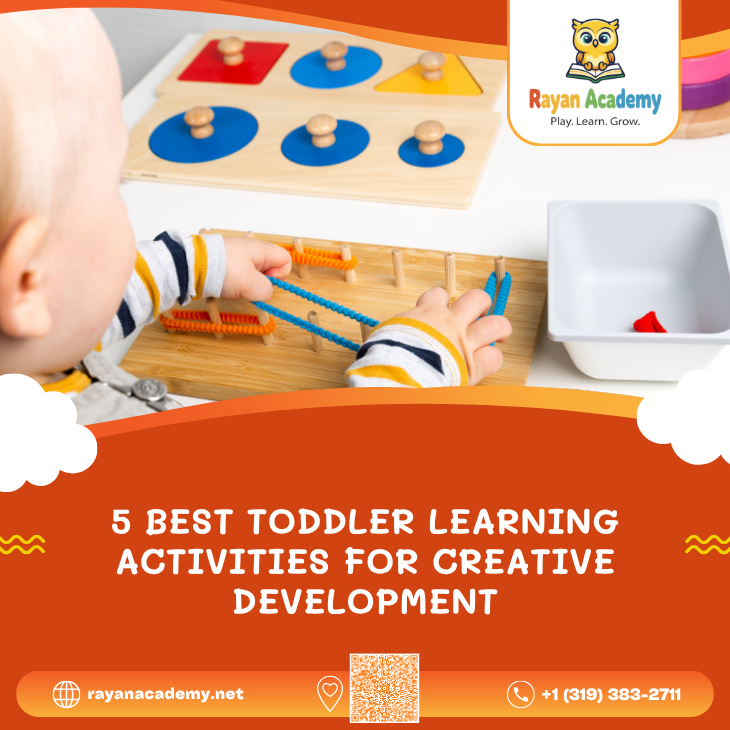
Sensory play is how toddlers make sense of the physical world. When a child scoops water between containers, squishes playdough, or runs their fingers through dry rice, they are not just having fun — they are building fine motor skills, strengthening hand-eye coordination, and developing early problem-solving instincts.
The beauty of sensory activities is their simplicity and accessibility:
- A kitchen colander and some pipe cleaners becomes a fine motor threading station
- A shallow tray of shaving cream turns into a canvas for letter tracing and free drawing
- Containers of different sizes teach volume, cause and effect, and spatial reasoning without a single instruction
In a structured daycare setting, educators take this further by rotating sensory stations and connecting play to emerging concepts like color, texture, and size. At Rayan Academy, dedicated play stations featuring art, music, and sensory exploration are woven into every child’s daily routine — not as occasional treats, but as core learning tools.
2. Early Literacy Through Stories and Songs
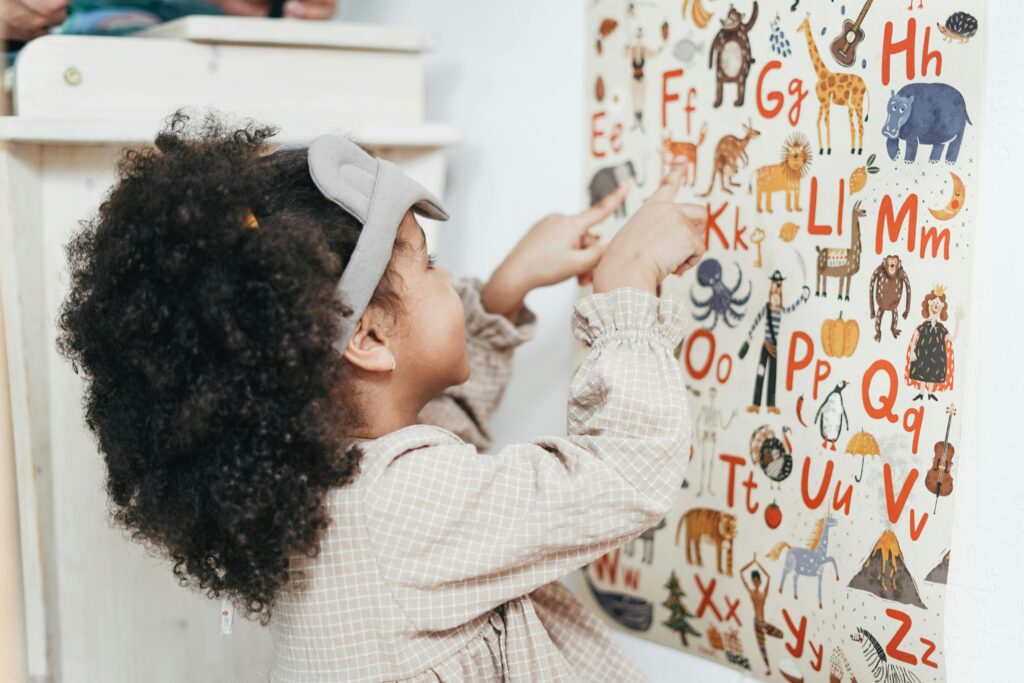
Long before a child reads their first word, literacy begins with listening, rhythm, and the back-and-forth of conversation. Reading aloud to toddlers — even when they squirm away after two pages — introduces vocabulary, sentence structure, and the comforting cadence of language. Songs and fingerplays add a physical dimension that anchors words in the body and makes recall easier.
To make the most of early literacy at home, try this simple daily approach:
- Read the same favorite books on repeat. Repetition builds word recognition and gives toddlers the thrill of predicting what comes next.
- Pause mid-sentence and let your child fill in the word. This small shift turns passive listening into active participation.
- Pair songs with hand motions. “Itsy Bitsy Spider” is not just entertainment — it is a multi-sensory language lesson.
- Narrate your day out loud. “Now we’re putting on your shoes. One shoe, two shoes!” builds vocabulary in real-world context.
Quality early education centers build these practices into daily circle time and story sessions, giving toddlers consistent, group-based exposure to language that complements what they hear at home.
3. Creative Art and Imaginative Play
Hand a toddler a fat crayon and a blank sheet of paper, and you are not just keeping them busy. You are watching self-expression, hand-eye coordination, and creative thinking develop in real time. Finger painting, tearing paper, stamping with sponges, scribbling in wide arcs — every mark a toddler makes is a small act of confidence.
Imaginative play deserves equal attention. When a toddler pretends to cook dinner, care for a stuffed animal, or “fix” something with a toy hammer, they are processing emotions, practicing language, and experimenting with social roles.
The key is offering open-ended materials rather than rigid templates. A cardboard box can be a car, a house, or a spaceship. A scarf becomes a cape, a river, or a blanket. When adults follow a child’s lead during imaginative play instead of directing it, they reinforce something essential: the child’s own sense of agency and creative power.
Read more about: Quick Paper Plate Projects for Preschoolers and Toddlers
4. Building Social Skills Through Group Activities
Even toddlers engaged in parallel play — playing alongside rather than directly with other children — are absorbing critical social information. They watch. They imitate. They begin to understand that other people have feelings, preferences, and needs.
Group activities accelerate this learning in ways that are difficult to replicate at home:
- Passing a ball in a circle teaches turn-taking and patience
- Singing together builds a sense of belonging and shared experience
- Simple cooperative tasks like building a block tower with a partner introduce the basics of teamwork
- Navigating small conflicts with teacher support teaches emotional vocabulary and self-regulation
This is one of the strongest reasons many families explore daycare during the toddler years. A well-structured classroom gives children regular, guided opportunities to practice social skills with the support of educators trained to model kindness and help resolve conflicts with gentle language.
5. Outdoor Play and Physical Development
There is no substitute for fresh air, open space, and the freedom to move. Daily outdoor time supports gross motor development, spatial awareness, and sensory integration — and it provides a natural outlet for the boundless energy toddlers carry, which in turn supports better focus during quieter activities indoors.
But outdoor play is about more than physical health. Climbing a low structure teaches risk assessment. Digging in sand invites scientific thinking. Running with a friend builds social bonds. As part of Rayan Academy’s learning approach, outdoor exploration is a daily priority — building strong bodies and happy hearts in equal measure.
How Rayan Academy Brings Toddler Learning Activities to Life
Understanding what toddlers need is one thing. Delivering it consistently, in a safe and loving environment, day after day, is another. For families in Coralville and Iowa City, Rayan Academy offers an approach to early education that goes meaningfully beyond basic childcare.
A Structured Yet Flexible Daily Routine
Toddlers thrive on predictability, and Rayan Academy’s daily schedule reflects that understanding. Each day flows through a purposeful rhythm:
- Morning huddles where children greet friends, share stories, and transition gently into the day
- Rotating activity blocks covering early literacy, creative play, sensory exploration, and hands-on learning labs
- Healthy meals and snacks that fuel focus, energy, and growth throughout the day
- Daily outdoor time for running, climbing, and free exploration
What makes this routine special is its flexibility. Teachers observe each child’s energy, mood, and interests and adjust the flow accordingly. A toddler deeply engaged in a sensory bin is not pulled away for the sake of a rigid timetable. This child-centered responsiveness reflects current best practices in early childhood education — and it is something parents notice immediately when they visit.
Experienced Teachers Who Understand Toddlers
The quality of any toddler learning activity depends enormously on the adult facilitating it. Rayan Academy’s educators bring both professional training and genuine emotional warmth to the classroom. They understand that a toddler melting down over a broken cracker is not misbehaving — they are overwhelmed and need help naming their feelings. This kind of attunement builds trust, and trust is the foundation on which all real learning rests.
Teachers also maintain close communication with families, sharing updates on developmental progress and offering suggestions for extending learning at home. This partnership between educators and parents creates a consistent, seamless experience for every child — one where the classroom and home reinforce each other.
A Safe, Nurturing Environment in Coralville
Safety is the baseline requirement every parent evaluates first, and rightly so. Rayan Academy, located at 2251 1st Ave, Unit B, Coralville, IA 52241, maintains rigorous health and safety protocols covering secure entry, clean and age-appropriate classroom spaces, and constant adult supervision.
Families in both Coralville and Iowa City also benefit from flexible scheduling — including half-day, full-day, and extended-day options — and special tuition considerations for University of Iowa and UIHC-affiliated families. You can explore current rates using the tuition calculator on the Rayan Academy website.
What to Look for When Choosing a Daycare for Your Toddler
If you are evaluating centers, these five indicators separate outstanding programs from average ones:
- Low child-to-teacher ratios that allow individualized attention and responsive caregiving — not just crowd management.
- A play-based curriculum that balances structure with freedom, covering language, motor skills, social development, and creativity in age-appropriate ways.
- Transparent safety policies that are clearly documented, consistently enforced, and openly shared with families.
- Warm, qualified teachers who engage with children at eye level, use positive language, and genuinely enjoy their work.
- Open parent communication through regular updates, accessible handbooks, and standing invitations to visit or tour the facility.
A center that meets these standards is not just watching your child — it is actively investing in their development during the most formative years of their life.
Your Child’s Brightest Days Are Waiting at Rayan Academy
If you have been searching for a place where your toddler can learn, grow, and feel genuinely loved, we invite you to experience Rayan Academy firsthand. Our classrooms are built for discovery. Our teachers are passionate about early childhood. And our community of families across Coralville and Iowa City shares one belief: every child deserves a joyful, confident start.
Come walk through our doors, meet our educators, and watch your child light up in a space designed just for them. You can schedule a tour at a time that works for your family, or explore enrollment options to learn about availability, tuition, and flexible scheduling. We would love to welcome your family into ours.
Frequently Asked Questions
1. At what age should my child start daycare?
Many families begin as early as six weeks, especially when the center provides a secure, nurturing environment with trained infant caregivers. Toddlers in particular benefit from group settings because the social interaction and structured activities support language development and emotional growth in ways that are hard to replicate at home alone. The best time to start is when your family feels ready and you have found a center you genuinely trust.
2. How do I know if a daycare is the right fit for my toddler?
Visit in person — there is no substitute. Watch how teachers interact with children. Do they get down to the child’s level? Do they speak warmly and respond to big emotions with patience? Ask about the daily routine, curriculum philosophy, and how the center handles safety. A quality program will welcome your questions and encourage you to observe before making any commitment.
3. Will my toddler struggle to adjust to a new environment?
Some adjustment is completely normal. Tears at drop-off may last a few days or a few weeks, and that does not mean the experience is harmful. Consistent routines, familiar caregivers, and a warm goodbye ritual all help children settle in. Most toddlers begin looking forward to their days at daycare surprisingly quickly once they bond with their teachers and classmates.
4. What learning outcomes should I expect from toddler activities at daycare?
Through daily toddler learning activities at a quality center, children typically show measurable growth in vocabulary and communication, fine and gross motor coordination, social skills like sharing and turn-taking, emotional regulation, and early literacy and numeracy awareness. These gains build a strong foundation for a smooth, confident transition into preschool.
5. How does Rayan Academy keep toddlers safe during activities?
Rayan Academy follows comprehensive health and safety protocols covering classroom cleanliness, secure facility access, age-appropriate materials, and constant adult supervision. Teachers are trained to maintain safe environments while still encouraging exploration and independence. Parents can review all policies in detail on the handbook and policies page for full transparency.
Conclusion
The toddler years pass quickly, but the learning that happens during this stage echoes for a lifetime. Every sensory bin explored, every story read aloud, every outdoor adventure shared with a friend — these are the experiences that shape how a child thinks, feels, and connects with the world. Toddler learning activities are not extras or luxuries. They are the essential building blocks of confidence, curiosity, and resilience.
For families in Coralville and Iowa City, Rayan Academy offers a place where those building blocks are laid with care, expertise, and genuine love for every child. With experienced educators, a thoughtfully designed curriculum, and a deep commitment to safety and family partnership, Rayan Academy is more than a daycare — it is where little minds grow bright, one joyful day at a time.