Table of Contents
Quick Paper Plate Projects for Preschoolers and Toddlers
There is something magical about handing a child a simple paper plate and watching their imagination take flight. Paper plate projects for preschoolers are far more than a rainy-day activity — they build fine motor skills, spark creative thinking, and lay the groundwork for lifelong learning. For parents in Coralville and Iowa City looking for meaningful ways to support their child’s development, these projects are a perfect place to start.
At Rayan Academy, hands-on creativity is woven into every day. Our experienced educators know that when a three-year-old transforms a plain plate into a lion’s face or a vibrant rainbow, they are practicing critical thinking, developing coordination, and learning to express themselves — the very skills that prepare children for school and beyond.
Whether you want craft ideas for home or you are curious about why creative activities matter in early childhood education, this guide is for you. Below, you will find easy paper plate art projects for preschoolers, the developmental science behind them, and insight into how a quality daycare brings these benefits to life.
Why Paper Plate Crafts Are a Preschool Favorite
Paper plates are inexpensive, safe, and endlessly versatile. But the real value goes far beyond convenience — these simple crafts support critical developmental milestones during the most formative years of a child’s life.
Strengthening Fine Motor Skills
Every time a child cuts along a curve, squeezes a glue bottle, or paints within a circular shape, they strengthen the small muscles in their hands and fingers. These are the same muscles needed for writing, buttoning a coat, and using utensils — skills that matter deeply as children approach kindergarten.
What makes paper plate crafts particularly effective is their low-pressure, playful context. Children do not feel like they are “practicing” anything. They are simply making something fun. At Rayan Academy, our preschool and Pre-K program integrates creative activities like these into daily routines so children build essential skills naturally — without even realizing they are learning.
Sparking Problem-Solving and Cognitive Growth
When a child decides how to turn a flat plate into a three-dimensional butterfly, something remarkable happens in their brain. They begin exercising skills that extend well beyond the craft table:
- Planning and sequencing — figuring out what to do first, second, and third
- Spatial reasoning — understanding how flat shapes can fold, overlap, and become something new
- Flexible thinking — discovering that there is no single right answer and that mistakes can become happy accidents
Research in early childhood development consistently shows that creative play supports cognitive growth just as powerfully as structured academic lessons, particularly for children ages three to five.
Easy and Fun Paper Plate Art Projects for Preschoolers
Ready to get crafting? These beloved paper plate art projects for preschoolers can be adapted for different skill levels, learning themes, and seasons.
Paper Plate Animals
Animal crafts connect children to the natural world while building key skills. Here are three favorites that work beautifully at home or in the classroom:
- Lion Face — Paint a plate yellow and glue orange tissue paper strips around the edge for a mane. Add googly eyes and draw a nose. Children practice tearing, gluing, and arranging while exploring textures.
- Frog — Fold a green-painted plate in half, attach a curled red paper tongue, and add large circle eyes on top. This naturally introduces symmetry and folding concepts.
- Butterfly — Cut a plate in half for wings, decorate with paint or stickers, and attach a craft stick body in the center. Encourages pattern-making and color exploration.
Each of these can be expanded into a mini-lesson about animal habitats, sounds, or life cycles — turning a fifteen-minute craft into a rich, multi-sensory learning experience.
Paper Plate Weather Wheel
This project beautifully combines art with early science. Here is how to make one:
Divide a plate into four sections and help your child draw a sun, rain cloud, snowflake, and wind symbol. Attach a spinner arrow with a brass fastener in the center. Each morning, your child spins to the day’s weather — and suddenly, a simple craft becomes a daily observation ritual.
Why it works so well: Children learn to connect real-world events with visual symbols, build daily routine awareness, and practice vocabulary like “cloudy,” “windy,” and “partly sunny.” These are exactly the kinds of early literacy and science connections that make play-based learning so powerful.
Emotion Faces
Emotional literacy is one of the most important — and often overlooked — aspects of early development. This craft puts feelings front and center.
Provide markers, yarn for hair, and felt shapes for mouths and eyebrows. Then ask your child to create faces showing different emotions:
- Happy — a wide smile, bright eyes, maybe some colorful cheeks
- Sad — a downturned mouth, droopy eyebrows
- Surprised — a big open mouth and wide round eyes
- Angry — sharp eyebrows, a straight or squiggly mouth
As they build each face, talk about when they have felt that way. At Rayan Academy, our nurturing teachers regularly use activities like these to help children understand and express their emotions in a safe, supportive setting — because naming a feeling is the first step toward managing it.
Paper Plate Ocean Scene
Paint a plate blue, then bring the ocean to life. Add paper fish in different colors, green strip seaweed along the sides, and sand or crushed crackers glued along the bottom edge.
What makes this project special is its storytelling potential. Ask your child open-ended questions — Who lives in this ocean? Where is the fish going? What is hiding behind the seaweed? — and watch their language skills come alive. A single craft becomes a gateway to vocabulary building, narrative thinking, and creative expression, all in one joyful sitting.
How Paper Plate Projects Support Child Development
Understanding the developmental benefits behind creative play helps parents make informed choices — both about activities at home and about the daycare environment they choose for their child.
Play-Based Learning and School Readiness
Play-based learning is an educational approach where children acquire knowledge and skills through guided and free play rather than rote instruction. It may look simple from the outside, but a single paper plate craft session can teach an impressive range of concepts:
- Counting — “How many legs does a spider need?”
- Letter recognition — “Let’s make the letter S for snake!”
- Color theory — “What happens when we mix red and yellow?”
- Vocabulary — naming materials, describing textures, explaining choices
Children who learn through play tend to develop stronger problem-solving abilities, longer attention spans, and a more positive attitude toward school. This is exactly why the learning approach at Rayan Academy is rooted in hands-on exploration, creative thinking, and child-centered teaching methods that meet every child where they are.
Building Social Skills Through Group Projects
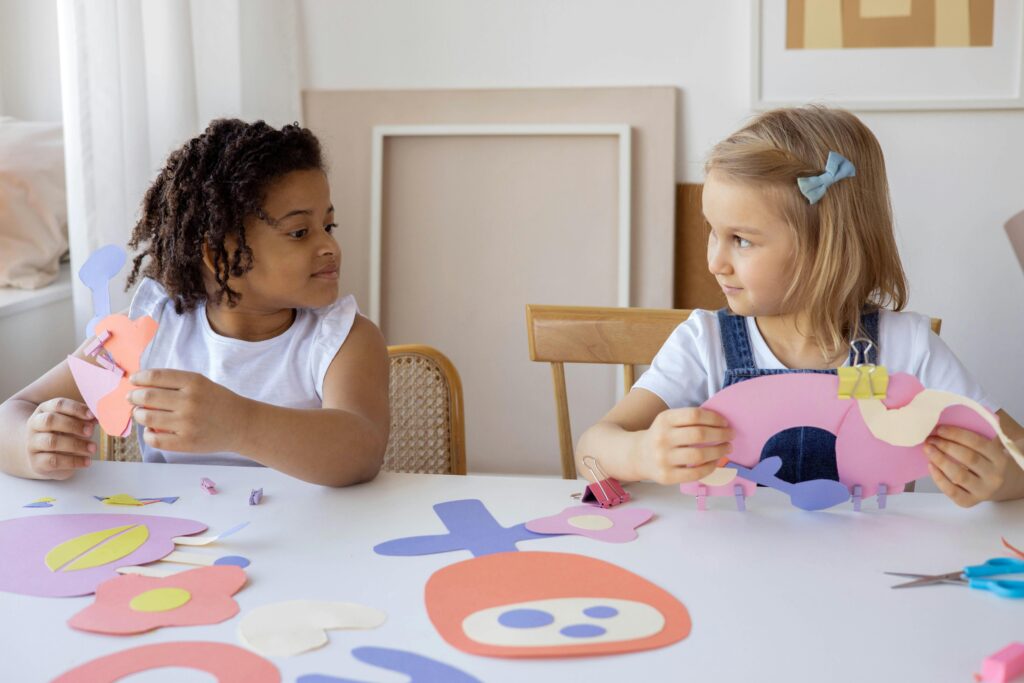
Something powerful happens when children sit together at a craft table. Group art sessions are among the richest opportunities for social growth in early childhood — not because of the project itself, but because of everything that happens around it.
Children learn to share supplies without being asked. They notice a friend struggling with scissors and offer help. They hold up their finished plate and say, “Look what I made!” — practicing pride, communication, and the joy of shared experience. These social skills are just as vital as academics when it comes to kindergarten readiness, and in a quality daycare setting, art activities are intentionally designed to nurture exactly this kind of growth.
Emotional Expression and Self-Confidence
Art gives children a voice before they have the vocabulary for complex feelings. A child painting a paper plate face with a big frown may be processing a tough morning. One covering their plate in glitter and bright colors might be celebrating a joyful mood. Allowing free creation — without rigid expectations — sends a powerful message: your ideas matter, and your feelings are valid.
During the preschool years, when children are actively forming a sense of self, this kind of encouragement significantly boosts self-esteem and willingness to try new things.
Read more about: The Impact of Before and After School Care on Child Growth
Choosing a Daycare That Values Creative Learning
For parents in Coralville and Iowa City evaluating childcare options, the presence of meaningful creative activities is an important signal of overall program quality. Here is what to look for when visiting a potential center:
- A balanced curriculum. The best programs weave art, music, and sensory play into every day — not as occasional extras, but as essential components of the learning experience. Look for a center where structured lessons and open-ended exploration go hand in hand.
- Experienced, caring teachers. Educators who truly understand child development can turn a simple paper plate project into a rich, multi-layered learning moment. They ask open-ended questions, scaffold activities for different ages, and create an atmosphere where every child feels safe to experiment and make mistakes.
- A safe, welcoming environment. From non-toxic art supplies to secure entry systems, safety should be non-negotiable. Parents should feel confident that their child is in a clean, well-maintained space with consistent routines and transparent policies.
- Strong family partnerships. A trustworthy daycare keeps parents informed about daily activities and developmental progress. Open, honest communication builds the kind of relationship that truly benefits every child.
Rayan Academy, located at 2251 1st Ave, Unit B, Coralville, IA 52241, is proud to offer all of these qualities. With programs designed for infants as young as six weeks through Pre-K and after-school care — plus flexible half-day, full-day, and extended-day scheduling — families throughout the Iowa City area have a dependable partner in their child’s early education.
Start Your Child’s Creative Learning Journey At Rayan Academy
Every paper plate craft your child completes is a small step toward bigger things — stronger hands for writing, a richer vocabulary for storytelling, and the confidence to walk into kindergarten ready to shine. Choosing an environment that values this kind of meaningful, joyful learning is one of the most impactful decisions you can make as a parent.
At Rayan Academy, we bring hands-on creativity, structured learning, and heartfelt care together every single day for families in Coralville and Iowa City. Here is how to take the next step:
- See our classrooms in action — schedule a tour of our warm, welcoming facility and meet the teachers who make each day special.
- Find the right fit for your child — explore options for infants, toddlers, preschoolers, and school-age children, each designed around your child’s unique needs and developmental stage.
- Begin the enrollment process — check enrollment options and discover the schedule and tuition plan that works best for your family.
You can also reach us directly at +1 (319) 383-2711 or support@rayanacademy.net. We would love to welcome your family into ours.
Frequently Asked Questions
1. What is the best age to start daycare?
Many families begin as early as six weeks, particularly when they choose a center with dedicated infant care focused on bonding, sensory exploration, and comforting routines. There is no single right age — what matters most is finding a warm, safe environment that responds to your child’s individual developmental stage and your family’s unique needs.
2. How do I choose the right daycare for my child?
Visit the center in person and watch how teachers interact with children. Look for genuine warmth, patience, and attentiveness. Ask about the daily schedule, teacher qualifications, safety protocols, and how the center handles challenges like separation anxiety. A quality program will welcome every question and encourage you to be an active partner in your child’s care.
3. How long does it take for a child to adjust to daycare?
Most children settle in within two to four weeks as they build trust with their teachers and form friendships. Consistent routines, a comfort item from home, and plenty of reassurance from experienced staff make the transition smoother. At Rayan Academy, our educators are skilled at helping every child feel safe and loved from day one.
4. How do paper plate projects for preschoolers support real learning?
These crafts develop fine motor skills, encourage creative problem-solving, and introduce early academic concepts like counting, colors, shapes, and letters. They also support emotional growth by giving children a safe outlet for self-expression and a meaningful way to build confidence through creating something entirely their own.
5. What safety measures should I look for in a daycare?
Key indicators include secure entry systems, clean and well-maintained facilities, low child-to-teacher ratios, non-toxic and age-appropriate materials, and clearly documented emergency procedures. All policies should be transparent and readily accessible to families. Rayan Academy maintains rigorous health and safety standards to ensure every child is protected and cared for throughout the day.
Conclusion
Paper plate projects for preschoolers may seem simple on the surface, but they represent something much deeper — the power of creative, hands-on learning to shape a child’s cognitive, social, and emotional development. When children cut, paint, and glue, they are building the skills and confidence they need for school and for life.
For families in Coralville and Iowa City, finding a daycare that values this kind of purposeful play is essential. Rayan Academy is committed to nurturing every child’s curiosity, creativity, and joy through experienced teaching, a safe environment, and a curriculum designed to help little minds grow bright. Because the best early education does not just prepare children for kindergarten — it helps them fall in love with learning.