Table of Contents
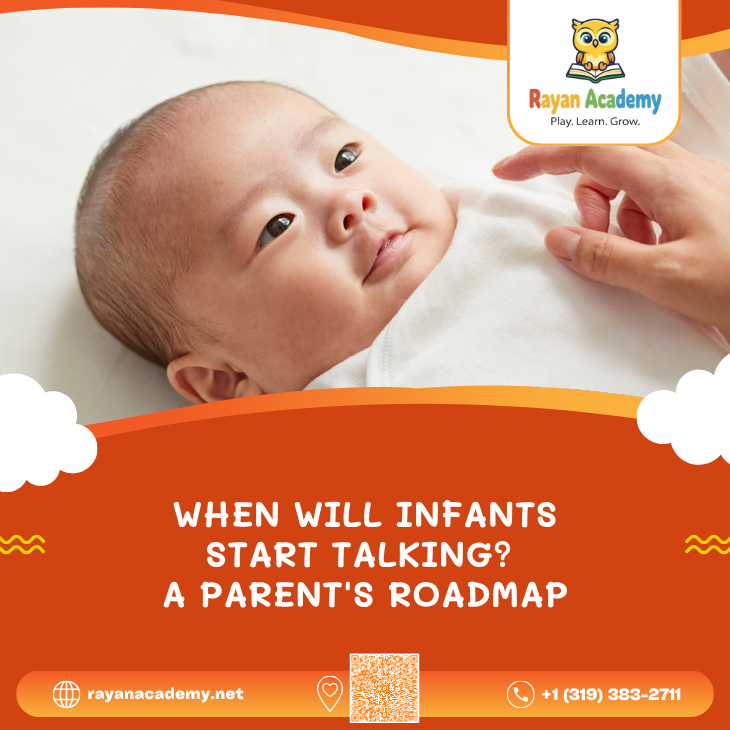
When Will Infants Start Talking? A Parent’s Roadmap
There are few moments more magical than hearing your baby’s first real word. One day it’s coos and giggles, and the next, a tiny voice is calling “mama” or “dada” across the room. If you’ve found yourself wondering when will infants start talking, you’re in wonderful company — it’s one of the most common questions parents across Coralville and Iowa City ask us.
The truth is that language blossoms gradually, long before that first word ever arrives. Every coo, babble, and curious stare is part of the journey. Understanding the timeline can ease your worries and help you nurture your little one with quiet confidence.
At Rayan Academy, we witness these beautiful first words every single day. Our nurturing teachers and language-rich classrooms are designed to spark communication from the very beginning — and you can learn more about how we support your baby’s growth in our infant and toddler care programs. Let’s walk through the milestones together, so you know exactly what to expect and how to help.
When Will Infants Start Talking? The Typical Timeline
Speech doesn’t arrive overnight — it unfolds in predictable, beautiful stages. While every child is unique, most infants follow a recognizable pattern from their very first cry to their first true word.
From Coos to First Words: A Month-by-Month Guide
Most babies say their first recognizable word between 10 and 14 months, with many landing right around their first birthday. Here’s how the journey typically unfolds:
| Age Range | What You’ll Hear | Key Milestone |
|---|---|---|
| 0–3 months | Cooing, gurgling, crying | Recognizes familiar voices |
| 4–6 months | Babbling (“ba,” “ga”), laughing | Responds to sounds and tone |
| 7–9 months | Repetitive babble (“bababa”) | Responds to their own name |
| 10–14 months | First true words (“mama,” “dada”) | Understands “no” and simple words |
| 15–18 months | 10–20 words | Follows simple directions |
| 18–24 months | 50+ words, two-word phrases | The “word explosion” begins |
| 2–3 years | Short sentences (3+ words) | Vocabulary grows rapidly |
If you’ve been asking when will my infant start talking, this chart offers a reassuring map — but remember, a few months in either direction is completely normal.
Understanding Before Speaking: Receptive vs. Expressive Language
Here’s something many parents don’t realize: your baby understands far more than they can say.
- Receptive language is what your child comprehends — and it always develops first. Long before talking, your baby recognizes their name, follows your gaze, and reacts to “bye-bye.”
- Expressive language is what your child produces — the actual words, gestures, and eventually sentences.
So even during the quiet, pre-verbal months, your infant’s brain is busy absorbing every word you say. Those one-sided “conversations” you have during diaper changes? They’re building the foundation for speech.
What Influences When Your Infant Starts Talking?
No two children develop on the exact same schedule, and that’s perfectly okay. Several factors shape when will infant start talking — and many are well within your influence.
Everyday Habits That Spark Speech
You don’t need flashcards or fancy programs. The most powerful language tools are simple, daily moments:
- Narrate your day. Describe what you’re doing — “Now we’re washing your hands!” — to flood your baby with vocabulary.
- Read together early and often. Even newborns benefit from hearing the rhythm and music of language.
- Pause and respond. When your baby babbles, answer back. This “serve and return” teaches the give-and-take of conversation.
- Sing songs and rhymes. Repetition and melody make words stick.
- Limit background screens. Live, face-to-face interaction builds language far better than passive media.
The Power of a Language-Rich Environment
Children learn to talk by being surrounded by talk. A language-rich environment is one filled with words, stories, songs, questions, and responsive adults who listen.
This is exactly why a child’s daily setting matters so much. Whether at home or in a quality childcare program, the more meaningful conversation a child hears, the faster their own voice emerges.
Read more about: Easy, Expert-Backed Activities for Toddlers to Try
How Quality Childcare Supports Early Language Development
Many Coralville and Iowa City families wonder whether daycare helps or hinders speech. The research — and our daily experience — points clearly to a benefit: high-quality early care can accelerate language growth through rich social interaction and intentional teaching.
Play-Based Learning: Where Words Come Alive
At the heart of strong early education is play-based learning — the idea that children learn best through hands-on, joyful exploration rather than rote drills.
When toddlers stack blocks, sort colors, or pretend to cook, teachers gently introduce new words in context: tall, balance, more, pour. Because the child is engaged and having fun, those words stick naturally. Our classrooms turn morning huddles, play stations, and story time into daily language workouts that never feel like work.
Social Interaction Builds Communication
Talking is, at its core, a social act. Children learn to communicate because they want to connect with others.
- Peer modeling: Toddlers imitate slightly older friends, picking up words and phrases quickly.
- Turn-taking games: Sharing toys and waiting for a turn teaches conversational rhythm.
- Group routines: Singing, greetings, and circle time build vocabulary in a warm, repetitive way.
In a setting full of friendly faces, your little one has endless natural reasons to find their words.
Early Literacy and Emotional Development: The Hidden Building Blocks
Speech doesn’t grow in isolation. Two quieter forces — early literacy and emotional security — work behind the scenes to help your child find their voice.
- Early literacy isn’t about reading at age two. It’s about the foundational love of language: recognizing that pictures have meaning, that stories have a beginning and end, and that print carries words. Each shared book strengthens the vocabulary and listening skills your child will eventually speak with.
- Emotional development matters just as much. A child who feels safe, seen, and secure is a child who feels free to experiment with sounds and words. When a nurturing teacher offers comfort and encouragement, a toddler gains the confidence to keep trying — even when “spaghetti” comes out as “pasketti.” That patient, loving response is the soil in which language grows.
Choosing the Right Daycare in Coralville & Iowa City
If you’re evaluating childcare while wondering when your baby will hit their next milestone, you’re really asking one bigger question: Where will my child thrive? Here’s how to choose with confidence.
What to Look For in a Speech-Supportive Program
Use this quick checklist when touring any local center:
- Low child-to-teacher ratios so every child gets individual attention and conversation.
- Warm, responsive educators who narrate, sing, and read throughout the day.
- A clear, intentional curriculum that weaves language into play.
- A safe, clean, health-focused environment that lets children explore freely.
- Transparent communication with parents about daily progress.
How Rayan Academy Supports Every Stage
Located at 2251 1st Ave in Coralville and serving the greater Iowa City area, Rayan Academy offers nurturing care designed to grow with your child:
| Program | Ages | Language Focus |
|---|---|---|
| Infants & Toddlers | 6 weeks – 2 years | Babbling, first words, responsive talk |
| Preschool & Pre-K | 3 – 5 years | Sentences, storytelling, early literacy |
| After School & Summer | School-age | Vocabulary, reading, social conversation |
We also offer flexible half-day, full-day, and extended-day scheduling to fit your family’s rhythm. To see how our curriculum builds communication skills, explore our preschool and Pre-K program or our after-school and summer care options. When you’re ready, you can easily check our enrollment options to find the right fit.
When to Talk to Your Pediatrician About Speech
Most children develop on their own timeline, but a few gentle benchmarks can help you know when to seek a professional opinion. Consider checking with your pediatrician if your child:
- Is not babbling by 12 months
- Has no words by 16 months
- Cannot combine two words (like “more milk”) by 24 months
- Loses language skills they previously had at any age
- Rarely makes eye contact or responds to their name
Early support is powerful — and reaching out early is never an overreaction. Trust your instincts; you know your child best.
Give Your Child a Joyful Start at Rayan Academy
Watching your baby discover their voice is one of parenthood’s greatest joys — and you don’t have to navigate it alone. At Rayan Academy, your child will grow in a safe, caring environment led by experienced teachers who celebrate every coo, babble, and breakthrough word.
Here’s what families across Coralville and Iowa City love about us:
- A safe, nurturing environment where curiosity is welcomed every day
- Experienced, loving educators who model language all day long
- A structured, play-based curriculum that turns fun into learning
- Transparent tuition and flexible schedules that fit real family life
Ready to see it for yourself? We’d love to welcome you. Schedule a tour to walk through our bright, joyful classrooms, or reach out to our friendly team with any questions. Your child’s brightest start could begin right here in Coralville.
Frequently Asked Questions
1. When will my infant start talking?
Most infants say their first true word between 10 and 14 months, often around their first birthday. Before that, expect plenty of cooing and babbling, which are essential building blocks. Remember, a few months of variation is completely normal.
2. Is babbling a sign my baby will talk soon?
Yes — babbling is one of the most encouraging early signs. When your baby strings together sounds like “bababa” or “dadada,” they’re practicing the building blocks of real speech. Respond enthusiastically to keep the momentum going.
3. Does daycare help babies learn to talk faster?
Quality childcare can absolutely support language growth through rich social interaction, peer modeling, and intentional, conversation-filled play. Programs like those at Rayan Academy weave vocabulary into every part of the day. The key is warm, responsive teachers and low child-to-teacher ratios.
4. What if my child isn’t talking as early as others?
Try not to compare your child to others, as healthy timelines vary widely. Keep talking, reading, and singing together to encourage progress. If your child has no words by 16 months or no two-word phrases by 24 months, check in with your pediatrician for peace of mind.
5. How can I encourage my baby to talk at home?
Narrate your daily routines, read picture books together, sing songs, and pause to “answer” your baby’s babbles. These simple, loving interactions build vocabulary naturally. Live, face-to-face conversation is far more powerful than any screen.
Final Thoughts: Every Voice Has Its Own Timing
If you’ve been wondering when will infants start talking, the most reassuring answer is this: language unfolds beautifully, one small step at a time. From the first coo to the first sentence, your love, attention, and everyday conversations are shaping a confident little communicator.
The early years truly do shape a child’s future — and the right environment makes all the difference. With nurturing teachers, a thoughtful curriculum, and a genuine commitment to safety and warmth, Rayan Academy is proud to help Coralville and Iowa City families give their children a joyful, language-rich start.
Your child’s voice is on its way. We’d be honored to help them find it.